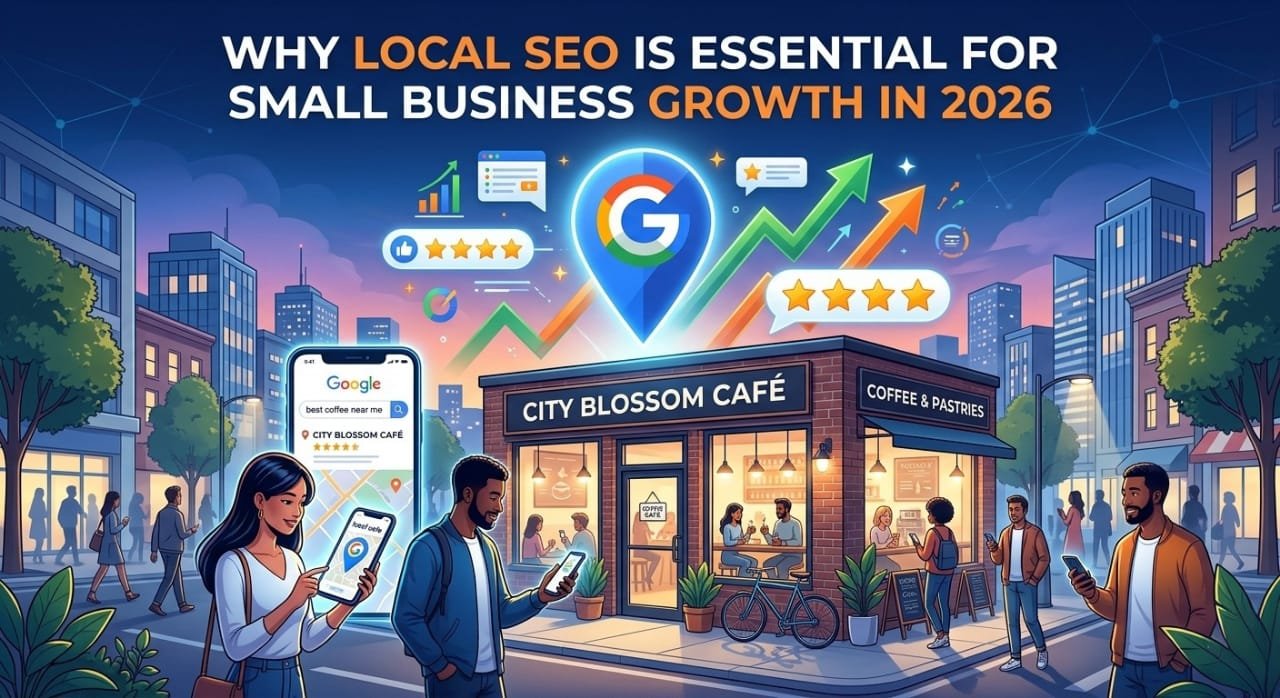
Local SEO is the most cost effective way for small businesses to get discovered by nearby customers who are ready to buy. In 2026, with 46% of all Google searches having local intent and AI search tools reshaping how people find businesses, optimizing for local search is no longer optional. It is a survival strategy.
What Exactly is Local SEO and Why Should Small Businesses Care?
Local SEO helps your business appear when nearby customers search for products or services you offer. It matters because 76% of local searches result in same day store visits, making it one of the highest-converting marketing channels available.
Here is the reality: 76% of local searches result in same day store visits. When someone searches for “plumber near me” or “best coffee shop in Delhi,” they are not casually browsing. They are ready to take action. Nearly 80% of U.S. consumers search for local businesses weekly, and 32% do so daily. That is a massive audience actively looking for businesses like yours.
How is local SEO different from traditional SEO? Traditional SEO focuses on improving visibility in standard organic results globally or nationally, while local SEO helps businesses show up in location based searches like “dentist near me” or “IT company in Delhi.” Local SEO uses specific signals like Google Business Profiles, local citations, and customer reviews to determine rankings.
For a company like AdLiveTech, an IT and digital marketing agency with over 10 years of experience, 45+ team members, and 1100+ completed projects located at H-162, 3rd Floor, H Block, Sector 63, Noida, Uttar Pradesh 201301, helps connect with businesses in Delhi that are actively searching for digital solutions. When local companies search for “IT company in Delhi” or “digital marketing agency near me,” strong local SEO ensures AdLiveTech appears right when those businesses need help.
But here is what most small business owners do not realize: 20% of local searches start directly with Google Maps, Apple Maps, or Bing Maps. If your business is not optimized for map searches, you are invisible to one in every five potential customers.
What Are the Biggest Benefits of Local SEO for Small Businesses?
Local SEO delivers high intent customers, better visibility on Google Maps, improved trust through reviews, and higher ROI than most paid advertising. It also helps small businesses compete with big brands on a level playing field.
How Does Local SEO Help You Reach Customers Who Are Ready to Buy?
People searching locally are already in “buying mode.” When someone types “IT services in Delhi” or “digital marketing agency near me,” they have a specific need and are likely comparing options to make a decision soon. Unlike broad keywords where users might just be researching, local searches signal immediate intent. The benefits of local search engine optimization include reaching customers at the exact moment they are ready to purchase.
Local and organic traffic makes up nearly 70% of all traffic to websites. And when those visitors come from local searches, they are far more likely to convert. Nearly 80% of smartphone searches for local businesses lead to an offline purchase. That means someone searching on their phone for your service is highly likely to walk through your door, call you, or book your service.
How does local SEO improve business? By connecting you with customers who are actively searching for what you offer in your specific geographic area. This targeted approach means higher conversion rates and better return on investment compared to broad marketing strategies.
Why Is Google Maps Ranking So Important for Local Businesses?
Google Maps listings and AI generated search tools are now dominating local search results, often appearing before traditional website listings. In 2026, Google’s local algorithm is built around three core pillars: relevance, distance, and prominence. While you cannot control how close your business is to every searcher, you can control how relevant and prominent your business appears.
Your primary Google Business Profile category is now the #1 ranking factor for Google Maps. Choose the wrong category, and you are essentially telling Google to show your business to the wrong people or no one at all. This is why understanding what are the key components of local SEO is essential for success.
How to improve Google Maps ranking? Start by selecting the most accurate primary category, adding complete business information, and regularly posting updates and photos to your profile.
Can Online Reviews Really Boost Your Local SEO Rankings?
In 2026, reviews influence map rankings, click through rate, trust, and AI recommendations. No reviews? Your business is effectively invisible. The advantages of local SEO extend beyond rankings. Reviews build the social proof that converts searchers into customers.
Google is moving from understanding ratings to interpreting sentiment. A 4.8 star rating tells Google people like your business, but the actual words in reviews matter just as much. Reviews that mention specific services, locations, or experiences help Google understand exactly what you offer and who you serve.
For AdLiveTech, client reviews like those from Anita J, Tushar S, and Colin M are not just social proof. They are ranking signals that help Google understand the quality and reliability of their IT and digital marketing services.
Is Local SEO Really More Cost-Effective Than Paid Advertising?
46% of marketers report better returns when implementing local SEO strategies. And with 65% of businesses now prioritizing local SEO in their marketing efforts, the competition is real but so is the opportunity. The benefits of local SEO for businesses include sustainable, long-term visibility without the ongoing costs of pay per click advertising.
Unlike Google Ads where you pay for every click, local SEO builds organic visibility that continues to work for you over time. Once you rank well locally, you maintain that position with consistent effort rather than continuous spending. This makes local SEO one of the most cost-effective digital marketing strategies available to small businesses.
Can Small Businesses Really Compete with Big Brands Using Local SEO?
Small businesses can outrank national chains in local search results. The benefits of optimizing for local search include the ability to compete with larger competitors by focusing on what matters most to local customers: proximity, relevance, and reputation. A well-optimized Google Business Profile with genuine reviews and accurate information can outperform a national chain’s generic listing.
How Does Local SEO Help Different Types of Businesses?
Benefits of local SEO for restaurants: Restaurants benefit from appearing in “near me” searches, with photos of dishes, menus, and real-time hours driving foot traffic.
Local SEO advantages for service based businesses: Plumbers, electricians, and cleaners benefit from emergency searches where proximity and trust are critical.
How local SEO helps small retail shops: Brick and mortar stores benefit from local packs and map listings that drive walk-in traffic.
Benefits of local SEO for healthcare providers: Patients search for doctors, dentists, and clinics nearby, making local visibility essential.
Local SEO benefits for real estate agents: Agents benefit from neighborhood-specific searches and community focused content.
Local SEO Tips for Beginners: Where Should You Start?
Beginners should claim their Google Business Profile, ensure consistent business information across all platforms, actively manage customer reviews, create hyper-local content, and make their website mobile friendly. These five steps form the foundation of any successful local SEO strategy.
Why Is Your Google Business Profile the Most Important First Step?
Your Google Business Profile (GBP) is the cornerstone of local SEO. Customers are 2.7 times more likely to trust a business with a complete, active profile. Understanding what types of businesses benefit from local SEO starts with recognizing that any business serving a local area needs a GBP.
What to do:
- Use your actual business address (Google will verify it)
- Choose the most specific primary category possible
- Add high-quality, location-specific photos regularly
- Update hours, especially for holidays
- Post updates about events, offers, or new services
Why Does Consistent Business Information Matter So Much?
80% of consumers lose trust when they find inconsistent information online. This is one of the most overlooked perks of local SEO. Simply maintaining consistency can significantly improve your rankings.
Create a master record of your business information and audit everywhere your business appears: your website, Google Business Profile, social media, delivery apps, and online directories. For AdLiveTech, ensuring consistent business information across all platforms helps Google and customers find them easily when searching for IT and digital marketing services in Delhi.
How Can You Get More Customer Reviews That Actually Help?
Reviews influence both your search rankings and whether customers choose your business. The effects of local SEO on small business growth are amplified by positive reviews that build trust and credibility.
What works in 2026:
- Quantity matters – more reviews signal an active business
- Quality matters – detailed reviews help with relevance
- Frequency matters – recent reviews show you are current
- Keywords inside reviews help Google understand what you offer
Always respond to reviews – both positive and negative. It shows you care about customer feedback.
What Kind of Content Should You Create for Local SEO?
Forget keyword stuffing. Google’s systems now detect and deprioritize forced, unnatural phrasing. Instead, create content that directly answers what your customers ask. The advantages of online marketing through content creation include establishing authority and answering customer questions before they even ask.
Hyper local content wins. Rather than a generic “IT services,” create content about “IT services for Delhi businesses” or “digital marketing for small businesses in India.” Each blog post is associated with a 7% increase in crawler visits and signals fresh, relevant content.
How to Improve Your Google Maps Ranking in 2026?
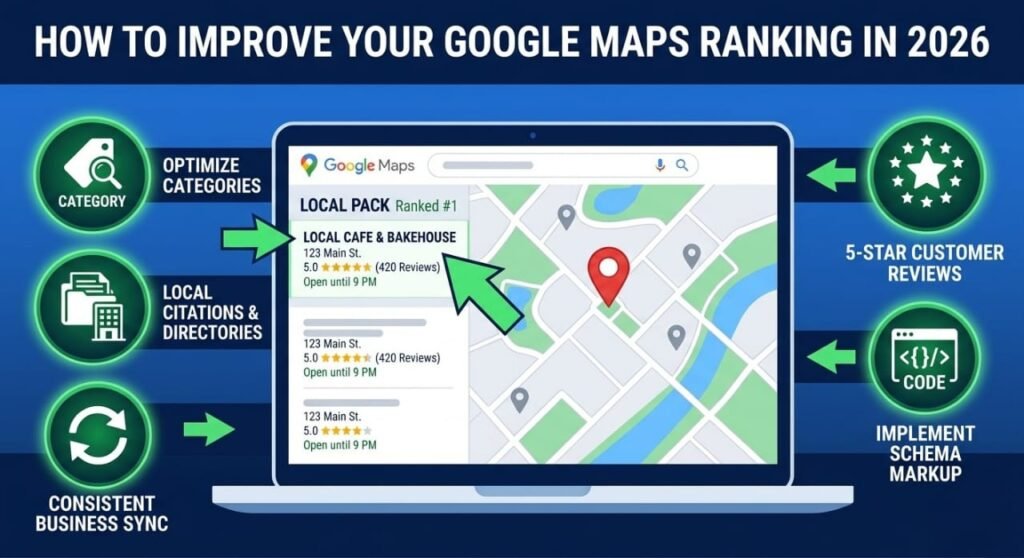
To improve your Google Maps ranking, optimize your primary category, build relevance through complete profiles, build prominence through reviews and backlinks, add schema markup, and synchronize your Google Business Profile information. These five actions send clear signals to Google about your local authority.
Getting found on Google Maps is not about luck. It is about sending clear signals to Google. Here is what actually moves the needle:
1. Optimize your primary category – it is the #1 ranking factor
2. Build relevance through complete profiles, specific categories, and services. The benefits of local search engine optimization include helping Google understand exactly what you offer.
3. Build prominence through reviews, backlinks, citations, and a consistent web presence
4. Add Local Business structured data (schema markup) to give Google information about your hours, offerings, reviews, and more
5. Synchronize your Google Business Profile to ensure crawlers see consistent and accurate information
Remember: distance is largely fixed, you cannot move your business closer to every searcher. But relevance and prominence are built. A business with strong relevance and prominence signals can outrank a geographically closer competitor. This is where local SEO’s role in enhancing online visibility becomes crucial. You can control how prominent and relevant you appear.
How Is AI Changing Local SEO and What Should You Do About It?
AI is transforming local SEO in three major ways – more people using AI to find businesses, Google AI Overviews reducing clicks, and voice search becoming more conversational. To stay ahead, focus on being the source of information AI tools pull from and optimize for natural language queries.
Why Are More People Using AI to Find Local Businesses?
This is the biggest shift in local search this year. Consumers using AI for local business recommendations surged from just 6% in 2025 to 45% in 2026. ChatGPT, Perplexity, and other AI platforms do not simply mirror Google’s results. They pull from their own databases of citations, reviews, directories, and brand mentions.
What this means for you: AI platforms now favor businesses with strong, consistent information across the web. Sites that are AI-optimized generate 320% more human traffic, 270% more form submissions, and 250% more click-to-call events. The long-term benefits of local SEO include being discovered not just on Google but across multiple AI-powered platforms.
Why Are Google AI Overviews Reducing Clicks to Websites?
Google AI Overviews, the AI generated summaries appearing above organic results, are reducing clicks for position one pages by 58%. This means even ranking #1 does not guarantee the traffic it used to.
The solution: Focus on being the source of information AI tools pull from. Sites with blogs, local schema, GBP synchronization, and dynamic pages are crawled 400% more than average.
Is Voice Search Still Important for Local SEO?
With voice assistants becoming more prevalent, how does local SEO work for voice searches? Voice searches tend to be longer, more conversational, and location-specific – like “Where can I find IT services near me?” Optimizing for natural language and featured snippets helps capture this growing segment.
Why Should You Invest in Local SEO Today?
Quick Answer: Local SEO is the most cost effective way for small businesses to attract customers in 2026. With 46% of all Google searches having local intent and AI search tools reshaping how people discover businesses, the businesses that invest in local visibility today will be the ones winning customers tomorrow.
Whether you are an IT company like AdLiveTech serving Delhi businesses or a local shop serving your neighborhood, the principles are the same: be findable, be trustworthy, and be where your customers are looking. Start with your Google Business Profile, build consistent information everywhere, earn genuine reviews, and create helpful local content. Your next customer is searching right now. Make sure they find you.
FAQs
1. What is local SEO and why does it matter for my small business?
Local SEO helps your business appear when nearby customers search for products or services you offer. It matters because 76% of local searches result in same day store visits, making it one of the highest converting marketing channels available.
2. How long does it take to see results from local SEO?
Most businesses start seeing improvements within 3-6 months of consistent effort. However, early signs like increased GBP views, more review requests, and better map visibility can appear within weeks.
3. Do I really need a Google Business Profile for local SEO?
Yes. It is the #1 most important factor. Your GBP is what Google shows when someone searches for a local service. Without one, you are invisible in local search results.
4. How many reviews do I need to rank well locally?
There is no magic number, but quantity, quality, and frequency all matter. A business with 75 recent, detailed reviews will typically outrank one with 5 old reviews. Focus on consistently earning new reviews rather than chasing a specific number.
5. What is the difference between local SEO and traditional SEO?
Traditional SEO focuses on improving visibility in standard organic results, while local SEO helps businesses show up in location-based searches like “dentist near me.” Local SEO uses specific signals like Google Business Profiles, local citations, and customer reviews to determine rankings.