

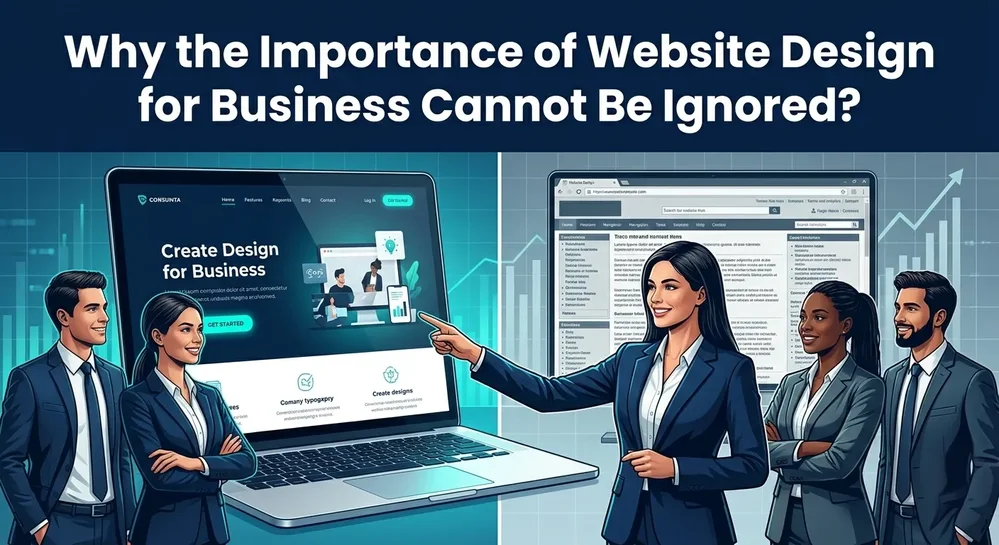
Your website is the single most powerful asset your business owns online, and its design determines whether visitors trust you, stay, or leave within seconds. The importance of website design for business goes far beyond how things look; it directly shapes customer perception, drives conversions, and defines your brand credibility at every digital touchpoint. If your website is not working hard for your business, it is actively working against it.
How Website Design Affects Customers and Their Buying Decisions?
First impressions online happen in milliseconds. Research consistently shows that users form an opinion about a website within 0.05 seconds of landing on it, and that judgment directly influences whether they stay, explore, or bounce. A cluttered, outdated, or confusing design sends one clear message to your potential customer: this business cannot be trusted.
When a visitor lands on your website, they are subconsciously evaluating your professionalism, your attention to detail, and your understanding of their needs. A visually appealing layout with clear navigation communicates that you take your business seriously. Contrast that with a site that has broken links, inconsistent fonts, and no clear call to action, that customer will click away and hand their money to your competitor in seconds.
Beyond aesthetics, website design directly affects how your customers feel. Colors, typography, white space, and imagery work together to create an emotional atmosphere. A law firm’s site needs to feel authoritative and calm. A children’s brand needs to feel playful and safe. When design aligns with your audience’s psychology, customers feel understood, and that emotional resonance is precisely what turns casual browsers into paying buyers. Teams like Adlivetech, with over a decade of hands-on experience building conversion focused websites, understand this psychological alignment and engineer it deliberately into every project they take on.
The Role of Visual Hierarchy in Guiding Customer Attention
Visual hierarchy is the strategic arrangement of design elements that guides your visitor’s eye toward what matters most, your value proposition, your key service, your call to action. Without it, visitors feel disoriented and uncertain about what to do next, and an uncertain visitor is a lost customer.
Effective visual hierarchy uses size, contrast, color, and spacing to prioritize information. Your most important message should be the very first thing a visitor registers. Supporting information follows naturally. Your call to action is always positioned where the eye lands after processing the core message. When this intentional flow is disrupted or missing, your conversion rate drops sharply, regardless of how good your actual product or service is.
Trust Signals That Your Website Design Must Communicate
Before any visitor makes a decision, whether that is filling out your contact form, making a purchase, or simply spending five more minutes on your site, they are actively scanning for trust signals. These include a professional logo, consistent brand colors, readable typography, SSL security indicators, and real client testimonials with authentic names and context.
A poorly designed website undermines every trust signal you attempt to place on it. Even a genuine five star review looks suspicious when it sits on a page that looks unreliable or unprofessional. Design is the frame around your credibility, and a broken frame damages the content inside it. If you are serious about building customer confidence online, your website design is where that work begins.
Website Design and User Experience: The Foundation of Online Success
User experience, commonly called UX, refers to how a person feels when interacting with your website: how effortlessly they find information, how fast pages respond, how logical the navigation flow is, and how satisfying the overall journey feels. The importance of website design for business is perhaps nowhere more measurable than in UX, because poor user experience directly kills conversions in ways that show up in your analytics and your revenue.
Great UX design begins with a deep understanding of your target audience. What are they actually looking for? What questions need to be answered before they feel ready to act? What frustrations do they carry from poor experiences on other websites? When your design answers those questions before the visitor even consciously formulates them, the experience feels effortless and natural. That seamless quality is what builds repeat visits, referrals, and long term customer loyalty.
Mobile responsiveness is no longer optional, it is a baseline expectation. With more than 60% of global web traffic now arriving from mobile devices, a website that renders beautifully on a desktop but breaks on a phone is a direct business liability. Responsive design ensures that your website adapts perfectly to every screen size, preserving usability, readability, and visual quality whether your customer is on a widescreen monitor or an older smartphone in poor lighting. At Adlivetech, mobile first design is treated as a nonnegotiable standard across all website development projects, not an afterthought added during final testing.
Navigation Design and Its Direct Effect on Bounce Rate
Navigation is the structural backbone of user experience. When visitors cannot find what they need within two to three clicks, they leave, and a high bounce rate tells search engines that your content is not satisfying user intent, which in turn damages your organic rankings. Poor navigation costs you twice: once in lost customers and once in lost SEO equity.
Smart navigation design keeps menus focused and limited to your most strategically important pages. It uses clear, descriptive labels instead of clever but cryptic ones. It ensures that every page offers a logical next step, whether that means reading a related article, viewing a service, or reaching your contact page. Navigation is not merely a design choice, it is a revenue generating system that either moves customers forward or sends them away.
Accessibility in Web Design: Reaching Every Customer You Deserve
Accessible website design means building a site that works for people with visual, auditory, motor, or cognitive differences. This includes sufficient color contrast, descriptive alt text for images, keyboard friendly navigation, and font sizes that do not require squinting. Beyond being ethically sound, accessibility measurably expands your addressable market and reduces legal exposure in many regions where accessibility compliance is mandated.
Accessibility and strong UX are not competing priorities, they reinforce each other. When you design for the most demanding use cases, the experience improves for every single visitor. A site with logical structure, clear labeling, and high contrast is simply easier and more pleasant for all users, regardless of ability level.
Why Businesses Need a Good Website: Beyond Just Having an Online Presence?
Many business owners make a costly mistake by treating their website as a digital business card, something that simply confirms the business exists. That mindset leaves enormous revenue potential entirely unrealized. A strategically designed website is your most tireless salesperson, operating continuously, reaching customers across geographies, qualifying leads, and generating inquiries while you focus on running your business.
The importance of website design for business extends well beyond the site itself. Your website is where your paid advertising campaigns send traffic. It is where your social media followers come to understand what you actually offer. It is where journalists, investors, and potential partners form their first serious impression of your organization. Every digital channel you invest in, email marketing, content, social media, paid search, ultimately drives back to your website. That means your website’s quality determines the real world ROI of every other marketing rupee you spend.
A professionally designed website also gives you full ownership over your brand narrative. On social platforms, algorithms decide who sees your content, when, and at what cost. On your website, you control the message, the design, the user journey, and the conversion path entirely. That ownership becomes strategically priceless as third party platforms grow increasingly expensive and unpredictable.

Website Design as a Competitive Differentiator in Your Industry
In virtually every industry today, your competitors have a website. The relevant question is no longer whether you need one, it is whether yours performs better than theirs. A superior website does not simply look more polished; it loads faster, communicates your value more immediately, and converts visitors at a measurably higher rate. These advantages compound month over month, creating a widening performance gap between businesses that invest thoughtfully in design and those that treat it as a line item to minimize.
How a Professional Website Anchors LongTerm Brand Building?
Brand consistency across all customer touchpoints builds recognition and trust over time, but that consistency needs an anchor. Your website sets the visual and tonal standard for your entire brand identity. The colors, typography, voice, and imagery established in your website design should carry through your email campaigns, social profiles, presentations, and offline materials. Without a professionally designed website as that foundation, maintaining meaningful brand consistency becomes structurally impossible.
Experienced agencies like Adlivetech approach website projects as complete brand communication systems, not just collections of pages, because they understand that design decisions made on the website ripple outward into every other channel the business operates.
Impact of Website Speed on Business Success
Website speed is not a technical detail that belongs in a developer’s conversation, it is a direct business metric that belongs in your revenue discussions. A onesecond delay in page load time can reduce conversions by up to 7%. When your site takes more than three seconds to load, more than half of your mobile visitors abandon it before a single word of your content is read. Speed is not separate from design, speed is part of the design.
Slow websites frustrate users, damage brand perception, and actively suppress your search engine visibility. Google has formally incorporated page speed into its ranking algorithm through its Core Web Vitals framework, which means a slow website does not only lose customers at the point of visit, it also loses organic traffic upstream because search engines deprioritize it in results. The damage compounds in two directions simultaneously.
Optimizing website speed involves strategic image compression, clean and efficient code, fast and reliable hosting infrastructure, content delivery networks, and careful management of third party scripts and plugins. None of these are optional refinements for businesses that are serious about digital performance. A visually stunning website that loads slowly is the equivalent of a beautifully designed store with a jammed front door, the experience fails completely before it even begins, and no amount of interior design can compensate for that failure.
Some of Our Recent Blogs
SMM vs SEO: Which is Better for New Businesses?
The Ultimate Guide to Digital Marketing for Startups in India
Why Every Startup Needs SEO from Day One?
FAQs
1. How does website design directly impact business revenue?
Website design shapes how long visitors stay, how much they trust your brand, and whether they take action, all of which directly determine your conversion rate and revenue.
2. What is the most important element of website design for small businesses?
For small businesses, trust building elements carry the greatest weight, a professional layout, clear contact information, authentic client testimonials, and fast load times.
3. How often should a business update or redesign its website?
Most experts recommend a full redesign every three to five years, with ongoing improvements throughout. Technology evolves, user expectations shift, and an outdated website can actively damage your brand perception and search rankings even if the business itself is thriving.
4. Does website design affect SEO performance?
Yes, profoundly. Search engines evaluate site structure, mobile responsiveness, page speed, and engagement metrics like bounce rate and time on page, all of which are direct products of your design decisions.
5. Can a poorly designed website hurt a business with a genuinely great product or service?
Absolutely. A strong product cannot overcome a website that communicates distrust, loads slowly, or leaves visitors confused about what to do next.