

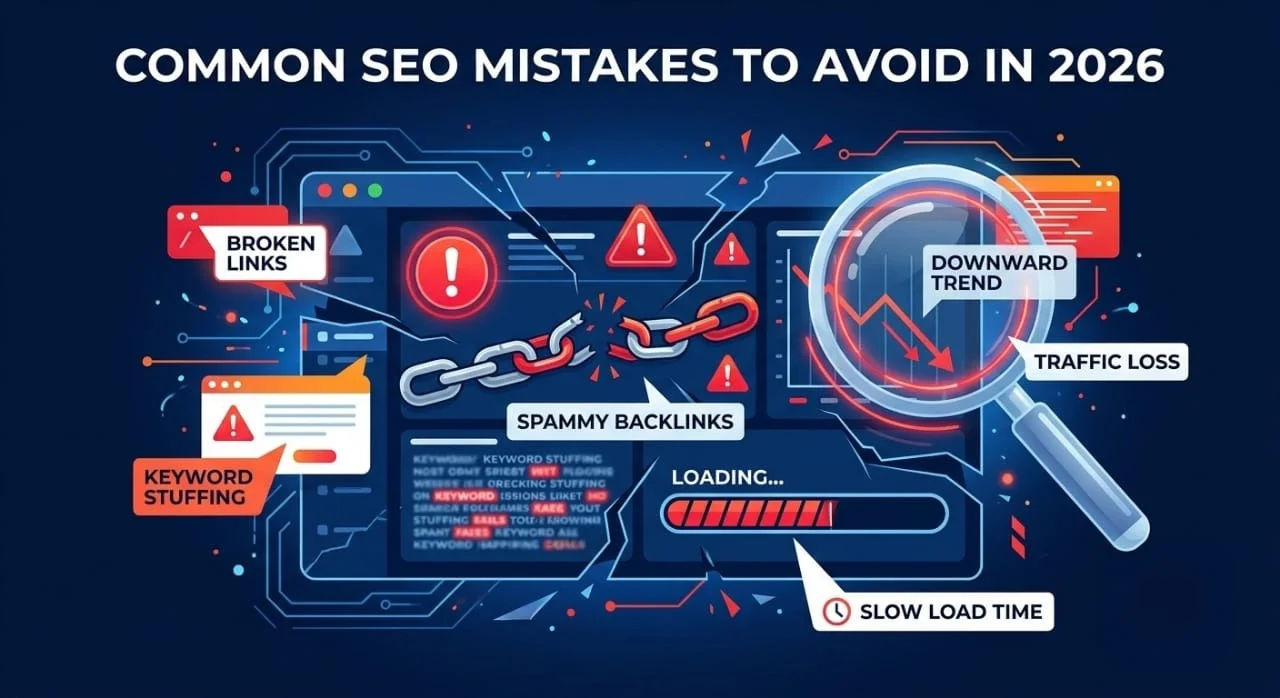
The biggest SEO mistakes in 2026 include ignoring technical SEO issues like broken links and slow load times, relying on mass AI-generated content without human oversight, keyword stuffing instead of writing for intent, neglecting mobile optimization, and chasing backlinks over building genuine authority. Fix these by running regular technical audits, creating content that demonstrates real expertise, optimizing for mobile-first indexing, and focusing on brand trust signals.
Is SEO Even Worth It in 2026?
Yes, SEO is absolutely worth it in 2026, but the old version of SEO is dead. The tactics that worked in 2019 are no longer the same. Today, SEO is about building authority, trust, and visibility across both traditional search and AI powered platforms.
SEO isn’t dead, but the tactics that once drove easy traffic are becoming obsolete as AI changes how people discover and evaluate information online. With Google’s AI Overviews now affecting 60 to 80 percent of informational searches, businesses that focus on brand visibility, customer trust, and high-intent search opportunities will win, not those still chasing rankings alone.
At AdLiveTech, a digital marketing and IT company with over 10 years of experience and 1100+ completed projects, we have seen firsthand how businesses that adapt their SEO strategy to 2026’s reality outperform those clinging to outdated methods.
Common SEO Errors That Hurt Rankings in 2026
1. Ignoring Technical SEO: The Foundation You Can’t Skip
Technical SEO errors like broken links, slow load times, duplicate content, and misconfigured redirects quietly kill rankings every day. Fix them first before writing any new content. Broken links, slow load times, duplicate content, and misconfigured redirects quietly destroy rankings every single day. These issues prevent search engines from properly crawling and indexing your site. Common crawl errors include DNS errors, 5xx server errors, redirect loops, 404s, soft 404s, broken links, and robots.txt blocks.
How to fix it: Use Google Search Console’s Coverage report and URL Inspection Tool to identify and prioritize errors. Run regular technical audits to catch issues before they impact rankings. As the 2026 SEO playbook advises: “Before writing a single new piece of content or chasing links, fix the basics. A leaking foundation cannot hold a house”.
2. Chasing Keywords Instead of Expertise
Keyword stuffing is a dying tactic in 2026. Google now rewards topical authority and genuine expertise over keyword frequency. Write for humans, not search engines. Keyword stuffing, cramming keywords into sentences, headings, or links purely for ranking purposes, triggers spam filters and repels customers. Today, keyword placement still influences click-through rates, but Google’s ranking signals are far more nuanced.
What to do instead: Build deep topical authority by covering one subject area thoroughly. Google now evaluates whether your content shows real, first-hand expertise, not just whether it contains the right keywords. “Mass AI content. No intent mapping. Weak internal linking. Zero conversion strategy”, these are the real problems.
3. Relying on Mass AI Content Without Human Oversight
Mass AI generated content without human editing and expertise is one of the fastest ways to tank your rankings in 2026. Google’s quality threshold is quietly killing scaled AI content. AI content gets blamed for traffic drops, but the real culprit is a content strategy that never survived beyond the freshness boost. AI simply amplifies existing weaknesses. The “freshness boost” that new URLs receive masks underlying issues, creating a temporary illusion of success.
Red flags that your AI content is hurting rankings:
- It has zero information gain
- High click-through but low engagement
- Offers generic expertise and is missing E-E-A-T
How to fix it: Use AI to help, not to do. Every piece of content needs human expertise, real case studies, and a credible point of view. Cheap content, keyword-stuffed pages, link-buying schemes, and “100 articles a month for $500” packages are dying.
4. Neglecting Mobile Optimization
Over 80 percent of searches are performed on smartphones. If your layout breaks or buttons are too small, mobile-first indexing will bury your site on page 10. Google uses mobile-first indexing, meaning it primarily uses the mobile version of your content for ranking and indexing. Mobile SEO requires a fundamentally different approach that prioritizes mobile user behavior, touch navigation, and the unique constraints of smaller screens.
What to check:
- Does your site load quickly on mobile?
- Are buttons and links easy to tap?
- Does content reflow properly on small screens?
- Are you using too much JavaScript that slows things down?
How to fix it: Optimize JavaScript execution and ensure your mobile experience is flawless. Fast mobile site speed is a top factor in both SEO and conversion performance, a one-second delay can impact mobile conversions by up to 20 percent.
5. Ignoring Core Web Vitals
Core Web Vitals are non-negotiable in 2026. INP has replaced FID as a critical metric, and 40 percent of sites that passed FID do not pass INP. Core Web Vitals measure:
- LCP (Largest Contentful Paint): Target under 2.5 seconds
- INP (Interaction to Next Paint): New metric replacing FID
- CLS (Cumulative Layout Shift): Visual stability
How to fix it: If INP appears red or yellow for mobile or desktop, you have a problem affecting your SEO. Common culprits include heavy above-the-fold content, autoplay videos, and poor caching strategies. Set max-age cache headers properly to avoid browsers revalidating assets on every visit.
6. Investing in Spammy Backlinks
Low quality backlinks from link farms, PBNs, and paid placements do not just fail to help, they actively hurt your rankings in 2026. Backlinks remain a ranking signal, but Google now evaluates them in real time and ignores most low-quality links instead of penalizing them. The December 2024 and October 2025 spam updates devalued link networks, paid placements, and AI-generated guest-post farms.
Common black hat tactics to avoid:
- PBN links and link farms
- Paid blog comment spam
- Negative link attacks
- Large-scale link exchanges
How to fix it: Focus on earning genuine backlinks through quality content, real relationships, and being a trusted source that both users AND AI systems reference.
7. Weak Internal Linking
Weak internal linking is an invisible killer. Traffic comes in, but nothing compounds because the content is not connected. Internal linking helps search engines understand your site structure and distributes authority across your pages. Without it, even great content remains isolated and underperforms.
How to fix it: Connect related content strategically. Build topic clusters where pillar pages link to supporting articles and vice versa. This signals to Google that you have deep expertise in a subject area.
8. No Conversion Strategy
Ranking without conversion is just vanity. If your SEO does not move users toward action, you are just publishing, not compounding. 2026 SEO is structured, intent-driven, and conversion-first. Top-of-funnel informational content has lost most of its commercial value, if someone searches “what is X,” they are now reading the AI summary and moving on.
What to do instead: Focus on the bottom of funnel(BOFU) SEO. Write comparison pages, alternative-to pages, city-specific landing pages, and case studies. Optimize for high-intent searches where users are ready to take action.
Outdated SEO Techniques You Must Stop in 2026
Stop keyword stuffing, buying links, publishing mass AI content, chasing rankings over conversions, and ignoring AI search visibility. These outdated techniques do not just fail, they actively hurt your rankings.
Here are the techniques that are officially obsolete in 2026:
- Keyword stuffing and exact-match placement
- Link-buying schemes and PBNs
- Mass AI content without human expertise
- Chasing rankings instead of conversions
- Ignoring AI search visibility
- Hidden text and article spinning
How to Fix Your SEO Mistakes in 2026?
Run a technical audit, fix all errors in Google Search Console, optimize for Core Web Vitals, create content that demonstrates real expertise, build internal links strategically, and focus on brand authority signals.

Your 7-step action plan:
- Fix your foundation – address all technical SEO errors in Google Search Console
- Optimize title tags and meta descriptions for every page
- Improve Core Web Vitals scores
- Audit your content – remove or improve thin, duplicate, or low-value pages
- Build topical authority – cover subjects deeply, not broadly
- Strengthen internal linking – connect related content strategically
- Monitor brand mentions and AI citations – track visibility beyond rankings
Conclusion
The common SEO errors we have covered all share a root cause: treating SEO as a game of tricks rather than a strategy for building genuine trust. Google has moved from being a keyword matching engine to a trust-evaluation engine. Your rankings now depend on how well your website signals authority, credibility, and real-world expertise.
To succeed in 2026, focus on these pillars:
- Technical health – fix broken links, Core Web Vitals, and mobile usability.
- Content that proves expertise, not just AI-generated filler, but content backed by case studies, named authors, and first-hand experience.
- Intent-driven optimisation, targeting high-intent queries that move users toward action, not just informational top-of-funnel traffic.
- Brand trust signals, such as a real business address, consistent NAP information across the web, genuine customer reviews, and a clear, transparent about page.
Remember: cheap content, link-buying schemes, and mass AI articles without oversight are dying tactics. The winners in 2026 will be those who invest in real relationships, authoritative content, and a seamless user experience.
At AdLiveTech, with 10+ years of experience, a team of 45+ professionals, and 1100+ completed projects, we have helped businesses shift from outdated SEO to strategies that actually deliver sustainable growth. If you are ready to stop chasing algorithms and start building authority that lasts, we are here to guide you. The shortcut era is over. The era of genuine expertise has begun, and it starts with fixing the mistakes that hold you back.
Frequently Asked Questions
1. Is SEO still relevant in 2026?
Yes, SEO is still relevant in 2026, but the old method of doing SEO is not benefiting more like creating backlinks in bulk and keyword stuffing. Now, SEO is more about building authority, trust and visibility across search engines as well as AI platforms.
2. What are the biggest SEO mistakes in 2026?
The biggest mistakes include ignoring technical SEO issues, creating generic content using AI with no proof of work or depth, doing keyword stuffing, creating spammy backlinks instead of creating genuine and high authority websites.
3. How do I fix poor SEO performance?
In order to fix poor SEO performance, start with technical audit using screaming frog, semrush, google search console, then improve the core web vitals making websites perform better for desktop and mobile. And lastly focus on building topical authority rather than publishing scattered content.
4. Does AI content hurt SEO in 2026?
No, AI content doesn’t hurt SEO in 2026, if used with proper research, human editing, proof of work using images, statistics. It is not useful only when the generic content generated is just copy and pasted.
5. What should I focus on for SEO in 2026?
Focus on building trust signals with named authors, real business addresses, consistent information across the web, genuine customer reviews, and content that proves your expertise. Optimize for conversions, not just rankings, and ensure your technical foundation is solid.